
A Smart Mat Walked Into a Biomechanics Lab. Here Is What Happened.
Flinders University researchers used the TrampleTek pressure-sensing mat as the trigger in a reactive jump-landing assessment. See how a $79 smart textile earned a spot in the lab.
TrampleTek was built for doorways, hallways, and activity spots (e.g. in front of the kitchen sink or fridge). It turns a footprint into a signal your smart home can act on.
Then a sports scientist in Adelaide asked it to do something different.
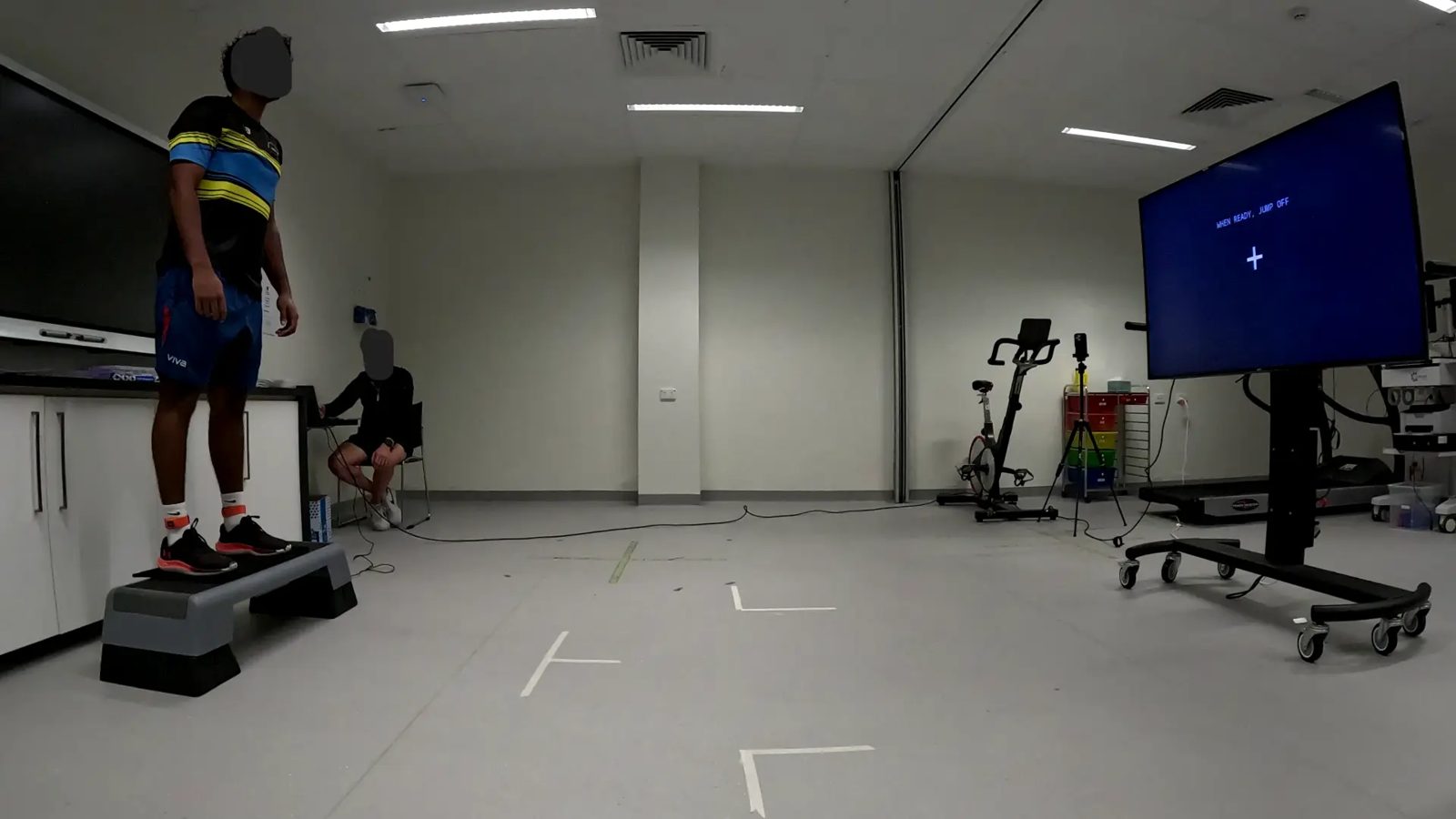
Dr. Cody Lindsay, a lecturer in Exercise and Sport Science at Flinders University, is developing a new way to assess how athletes land after a jump. His team needed a trigger: a device that could tell a computer, with no lag and no guesswork, that a participant had just left the box. They chose TrampleTek.
This post covers what they built, why a fabric pressure sensor fit the job, and what it says about where smart textiles are headed.
The test they wanted to improve
Sports medicine already has a well-known screen for landing mechanics called the Landing Error Scoring System, or LESS. Published in 2009, it asks a participant to jump forward off a box, land, and immediately jump straight up. Clinicians score the landing on a checklist of movement errors linked to lower-limb injury risk.
LESS is useful. It is also predictable. The athlete knows exactly what is coming.
Real sport is not predictable. A netball player lands and reacts to where the ball went. A footballer lands and cuts toward the runner. Injuries tend to happen in those split seconds of reaction, not in a rehearsed drill.
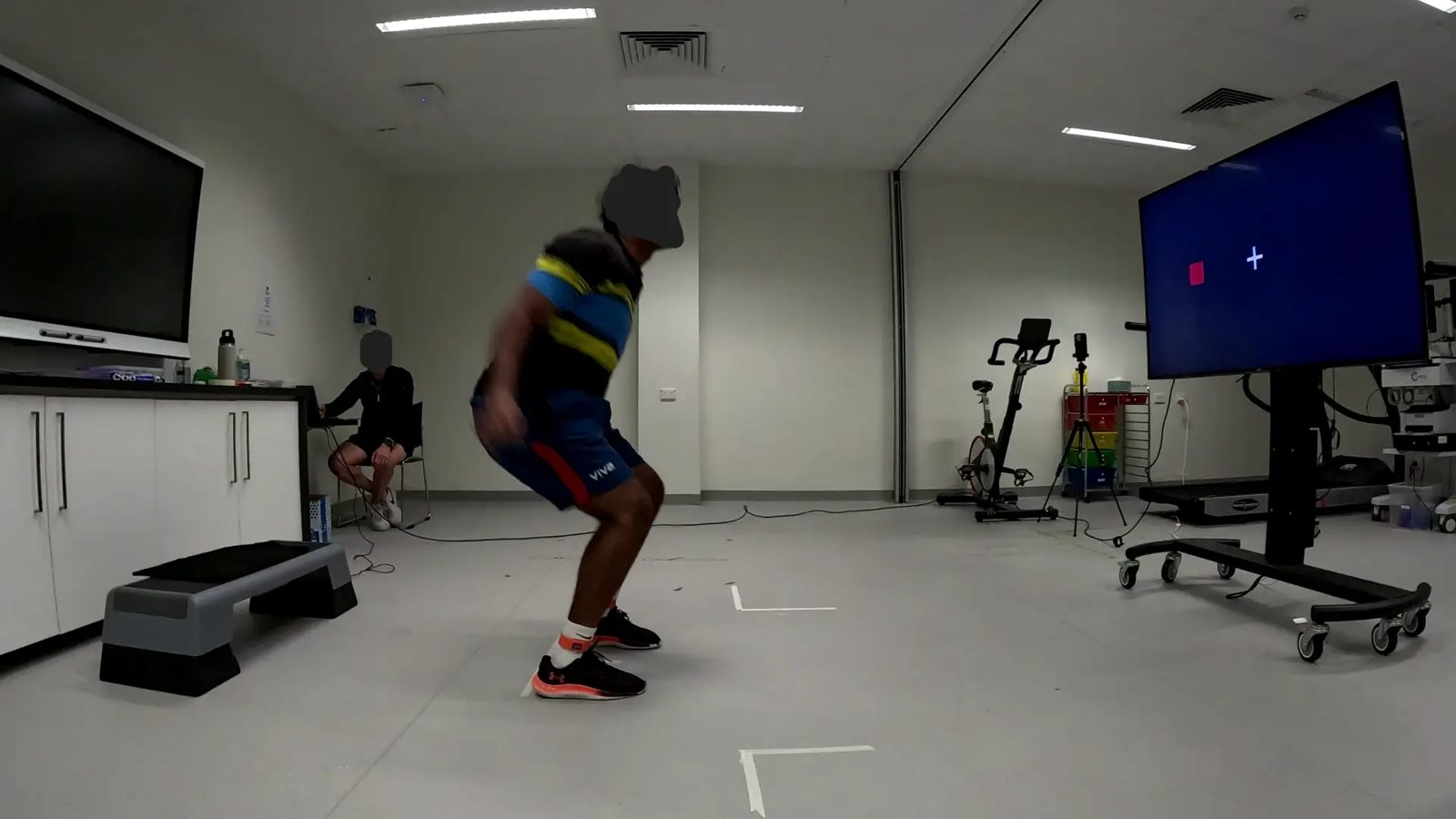
So the Flinders team set out to extend LESS with a reactive component. Instead of a known task, the participant would jump off the box and only learn which direction to jump next at the moment of landing. A screen would show the cue. The body would have to decide fast.
That design created an engineering problem. The screen had to know, precisely, when the athlete left the box.
Where TrampleTek came in
Here is how Cody described the setup:
"Positioned on top of a small box, the TrampleTek mat detected when participants jumped off the box and transmitted a signal to the stimulus program. This signal triggered the next phase of the assessment, presenting a directional cue that instructed participants which way to jump immediately upon landing."
Read that again with a systems hat on. The mat is the start switch for the entire trial.
- Participant stands on the mat on top of the box. Pressure present.
- Participant jumps. Pressure gone.
- TrampleTek sends the state change to the stimulus program.
- The program fires the directional cue on the display.
- Participant lands, reads the cue, and jumps left or right.
No wearable. No camera trained on the box. No research assistant hovering over a keyboard trying to hit spacebar at the right instant. The mat measured the jump-off directly and the rest of the rig followed.
Why a fabric sensor fit a lab
Labs are full of expensive instruments. Force plates, motion capture rigs, and high-speed cameras all have their place. TrampleTek did not replace any of them. It solved a smaller, specific job that those tools are not designed for: telling another system that a person just left a surface.
A few things made it a natural fit.
It measures presence, it does not infer it. A camera-based trigger has to interpret pixels. A timer has to guess. TrampleTek registers load on the fabric. Presence means presence. When the pressure drops, the athlete has left. That directness is what a stimulus program needs.
It talks to whatever you already run. TrampleTek is built on an ESP32 with Wi-Fi and Bluetooth LE. It speaks MQTT, REST, and ESPHome, and it works with Home Assistant out of the box. A research team can pipe the signal into a custom program the same way a homeowner pipes it into a light switch. Your protocol, your call.
It survives being jumped on. The mat is designed for foot traffic in busy hallways and entryways. Athletes launching off a box, trial after trial, is well inside its comfort zone.
It costs less than a lab lunch order. TrampleTek Blue currently sells for $79.99. For a research budget, that is the difference between "let's try it" and "let's write a grant."
It keeps the room private. The mat collects no images and no audio. It only knows load. For a study involving human participants, one less identifying data stream is one less consent and storage headache.
What the footage shows
Cody's team shared a few stills and a short clip. In the stills you can see the full picture: a participant on a small step box with the mat on top, a display across the room waiting to show the cue, and the taped landing zones on the floor. One frame catches the athlete mid-landing, knees bent, eyes already on the screen where a red square has just appeared.
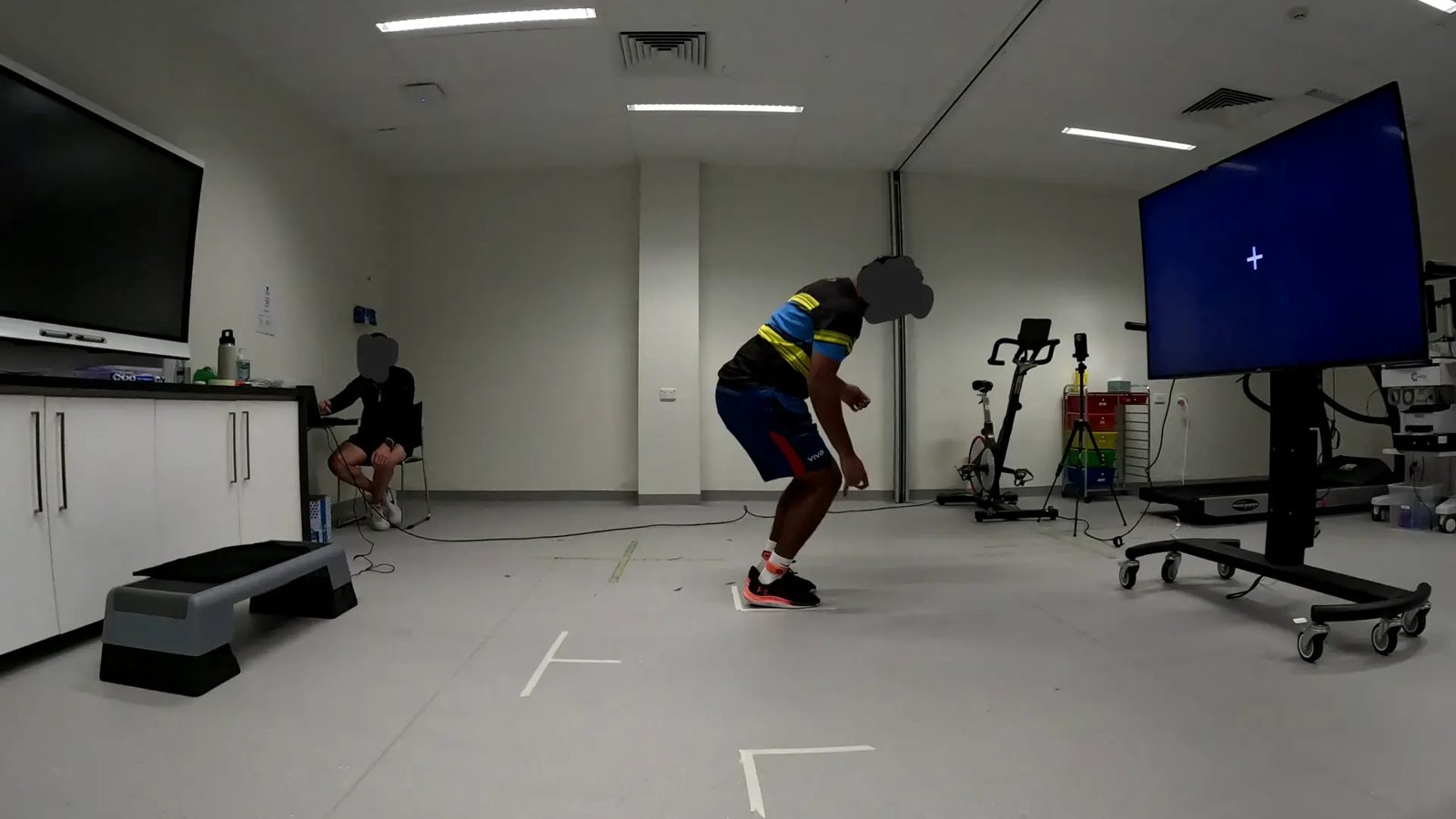
The clip below is a five-second skeletal reconstruction of the same jump-landing sequence. It is a reminder that the mat is one small link in a much bigger analysis chain. This was done with OpenCap.
Uhlrich SD, Falisse A, Kidzinski L, Muccini J, Ko M, Chaudhari AS, Hicks JL, Delp SL. OpenCap: Human movement dynamics from smartphone videos. PLoS Computational Biology. 2023 Oct 19;19(10):e1011462.
The bigger point
ASC does not make lab equipment. ASC makes smart textiles. The Flinders project is a good example of what happens when a sensor is simple enough, open enough, and honest enough about what it measures that people find jobs for it the designers never listed on the box. Sports science is one of those jobs. Others are already showing up: eldercare bed-exit detection, retail footfall counts, entry security, themed environments that respond to a footprint. Same fabric, same signal, different question.
If you run a lab, a clinic, or a product team and you need to know the instant someone steps on or off a surface, TrampleTek may be the least complicated part of your build.
Explore TrampleTek Blue, or talk to the partnerships team.
Our thanks to Dr. Cody Lindsay and the Exercise and Sport Science team in the College of Health and Enablement at Flinders University for sharing their work.